
Pastor's Notes
Greet the Saints, Discern the Snakes

Paul spends the first sixteen verses of Romans 16 greeting people by name. Then he pivots hard: "I urge you, note those who cause divisions." The sermon title captures this tension. The church is called to genuine love and affection for one another ("greet the saints") and simultaneous vigilance against those who fracture the body ("discern the snakes"). Both are non-negotiable. Neither cancels the other.
Context: Romans is Paul's most complete explanation of the gospel. Written to a church he did not plant and had likely never visited, the letter walks from justification through sanctification to the transformed life. By chapter 16, Paul is closing. He greets nearly thirty people by name. Then, in verses 17-20, he issues an urgent warning. The church in Rome was made up of Jewish and Gentile believers navigating life together. At points, the Jewish believers had been expelled from Rome under Emperor Claudius, returning to find a predominantly Gentile church. The soil was fertile for division. Paul's final charge is not abstract theology. It is a survival instruction for a real community.
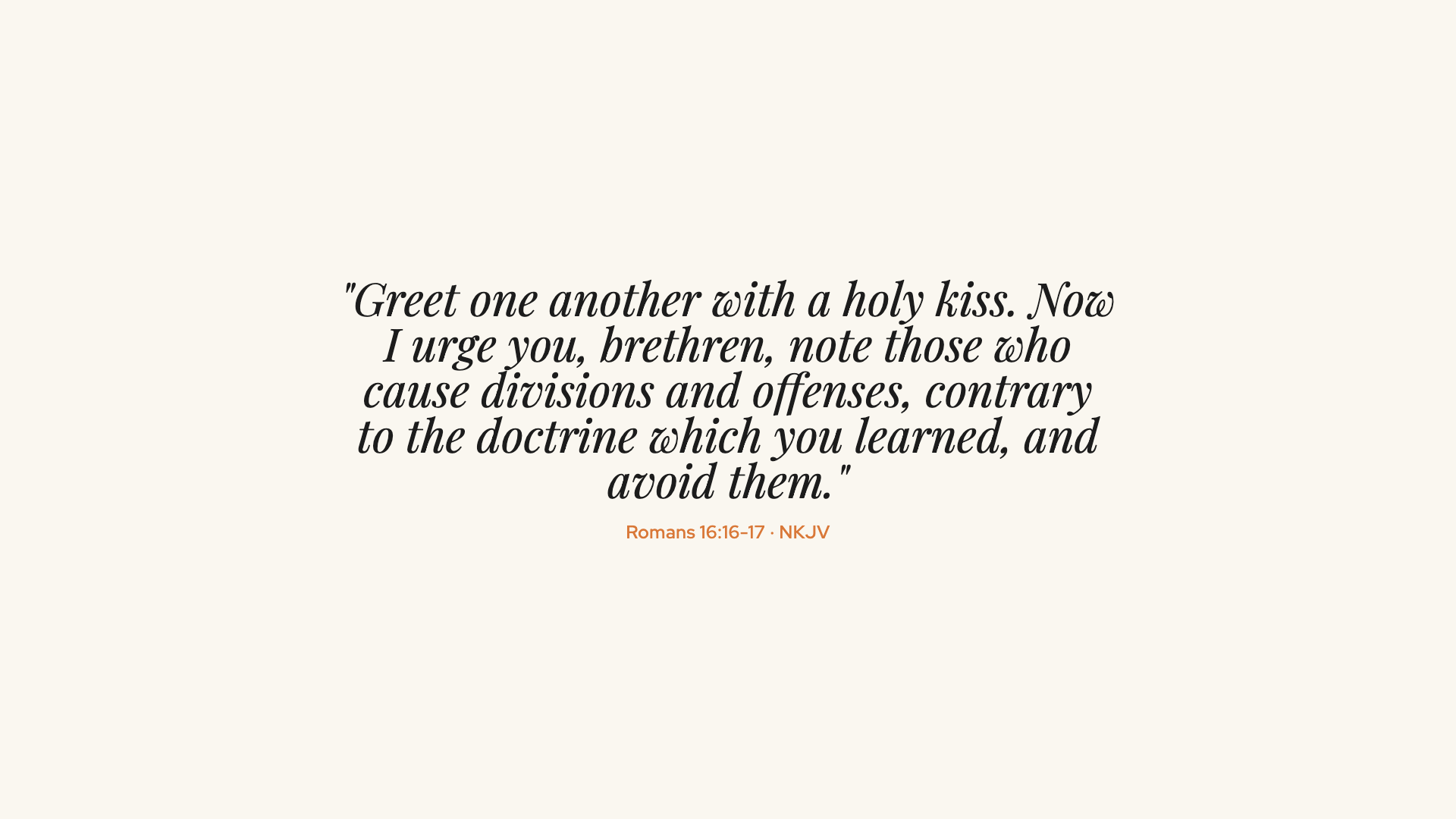
Detect the Spark: Detect It Small Before It Spreads
Paul calls the church to notice division early, before it spreads, because small things left unaddressed produce catastrophic outcomes.
Anchor verses: Romans 16:16-17
A. Unity is the baseline (v. 16)
Paul begins with "Greet one another with a holy kiss." This was a cultural expression of familial affection. The church is a family, not an institution. Unity expressed through genuine love is the normal state of the body. Division is the abnormality that must be addressed.
B. "Note those who cause divisions" (v. 17)
Paul uses urgent language. "I urge you." This is not a suggestion. The word "divisions" is dichostasia, appearing only here and in Galatians 5:20 where it is listed as a work of the flesh. It means "standing apart." The divisive person actively pulls people into separate camps. This is not disagreement. This is dissension.
Dichostasia (Greek: διχοστασία), "Divisions"
Rare in the New Testament (only Romans 16:17 and Galatians 5:20). The root means "to stand apart." It describes someone who creates factions, not someone who simply disagrees. Paul classifies it as a work of the flesh. Healthy disagreement can deepen understanding. Dichostasia creates hostility, suspicion, and separate sides.
C. Offenses as stumbling blocks
The word "offenses" is skandalon, the trigger stick of a snare or trap. The divisive person sets traps that cause others to stumble. They do not just hold a wrong opinion. They create conditions where others fall.
Skandalon (Greek: σκάνδαλον), "Offenses"
Originally the trigger of a trap. In the New Testament, it refers to anything that causes someone to stumble or fall into sin. A divisive person is not just unpleasant. They are dangerous. They lay snares for the unsuspecting.
D. Illustration: ValuJet Flight 592 (May 11, 1996)
A missing safety cap on a small oxygen canister in the cargo hold caused a fire that brought down the plane. 110 people died. The canister was small. The cap was smaller. The result was catastrophic. Division works the same way. A small comment. A planted suspicion. Overlooked, it grows into something that destroys the entire body.
E. Scripture supports the pattern
| Passage | Principle |
|---|---|
| James 3:5-6 | The tongue is a small member that kindles a great fire; it is set on fire by hell |
| Proverbs 26:20-21 | Where there is no wood, the fire goes out; a contentious man kindles strife |
| Song of Solomon 2:15 | The little foxes spoil the vines; small things destroy tender growth |
| Ecclesiastes 10:1 | Dead flies putrefy the perfumer's ointment; a little folly outweighs wisdom |
Application: Where is the spark in your life? In your relationships? In the church? Paul says to note it. Mark it. Do not look away. Put your boot on it while it is still small.

Discern the Source: See Beneath the Surface and Smooth Words
Deception succeeds through attractive presentation. Paul teaches the church to look beneath the surface and recognize the patterns that reveal true motives.
Anchor verses: Romans 16:18-19
A. They do not serve Christ but their own belly (v. 18)
"Belly" (koilia) refers to appetites, desires, self-interest. The divisive person frames their agenda as concern for the truth or the good of the church. Paul strips the mask. Their motive is self. Power. Admiration. Control. They position themselves as noble advocates while serving their own interests.
B. Smooth words and flattering speech (v. 18)
Chrēstologia (Greek: χρηστολογία), "Smooth Words"
"Fair speaking" that sounds good but is empty. The root chrēstos means useful or good. The irony is in the word itself. What sounds constructive is actually hollow. The packaging is attractive. The contents are nothing.
Eulogia (Greek: εὐλογία), "Flattering Speech"
The same word used for "blessing" and "good word." The deceiver co-opts spiritual language and twists it into manipulation. They sound edifying. They quote scripture. But the intent is to control, not to build up.
C. They target the "simple" (v. 18)
Akakos (Greek: ἄκακος), "Simple"
"Without evil." Not unintelligent. Unsuspecting. The honest person who does not expect deception because they would not deceive others. Dividers avoid mature believers because mature believers recognize the pattern and stop it. They seek out the young in faith, the vulnerable, those easily manipulated.
D. Illustration: Challenger Disaster (1986)
Engineers warned NASA that the O-ring seals would fail in cold temperatures. The launch proceeded anyway. Seven astronauts died 73 seconds after liftoff. The warnings were clear. The expertise was available. Leadership ignored it. Small daily compromises compound. Systems fall gradually before they fail dramatically. The same dynamic destroys churches. Warnings are dismissed. Patterns are normalized. Then catastrophe.
E. Be wise in good, simple concerning evil (v. 19)
Paul gives a practical principle. Do not study evil to become an expert in darkness. Become intimately familiar with what is good. The bank teller principle: tellers do not study counterfeit bills. They handle real currency so often that a fake feels wrong immediately. Know Christ deeply. Know the fruit of the Spirit. Then anything that does not align stands out on contact.
F. Patterns reveal the product
A consistent pattern prophesies the outcome. What pattern do you see in your own life? In your finances? In your relationships? Does this person repeatedly leave relational wreckage behind them? What is the fruit? Divisive people often begin with phrases like "I probably shouldn't say this, but..." or "Maybe I'm wrong, but..." Seeds are planted quietly. Others come along and water them. Division rarely enters through the front door announcing itself.


Direct Your Strength: Small Steps Snowball
The same principle that makes small compromises dangerous makes small acts of obedience powerful. Paul closes with a promise of victory and a call to faithfulness.
Anchor verses: Romans 16:19-20
A. The God of peace will crush Satan (v. 20)
Paul does not say "you will crush Satan." He says God will do it. Under your feet. Your position of rest is God's place of battle.
Syntribō (Greek: συντρίβω), "Crush"
To shatter completely. To break into pieces. Total destruction, not a temporary setback. God does not "handle" Satan. He crushes him. The promise is definitive and final. And it happens under the believer's feet.
B. Escape velocity: the effort to rise
A rocket requires enormous sustained force to break free from gravity. Left alone, gravity always pulls down. No effort is required to fall. Great effort is required to rise. Spiritually, the same principle holds. It is easier to drift than to pursue. Easier to criticize than to encourage. Easier to tear down than to build up. Paul calls believers to direct their energy upward, not sideways into division.
C. Small beginnings produce great outcomes
| Passage | Principle |
|---|---|
| Zechariah 4:10 | Do not despise the day of small things |
| Matthew 17:20 | Faith as a mustard seed moves mountains |
| Galatians 6:9 | Do not grow weary in doing good; in due season you will reap |
| Philippians 3:13 | Forgetting what is behind, reaching forward to what is ahead |
| Hebrews 2:1 | Give earnest heed lest we drift away |
| Matthew 5:9 | Blessed are the peacemakers |
| James 3:18 | The fruit of righteousness is sown in peace by peacemakers |
D. One person can stop the fire
"Where no wood is, the fire goes out" (Proverbs 26:20). One person refusing to participate in gossip stops an entire chain of damage. One person refusing offense prevents division from spreading through them. One peacemaker spares a family, a friendship, a church from wounds that may never heal. You may never know the disaster you prevented by choosing wisdom over participation.
Application: Do not underestimate small things. One prayer. One act of obedience. One conversation. One surrendered yes. The same God who warns you about division will empower you for unity. He does not ask you to win the battle. He asks you to stand while He crushes the enemy under your feet.

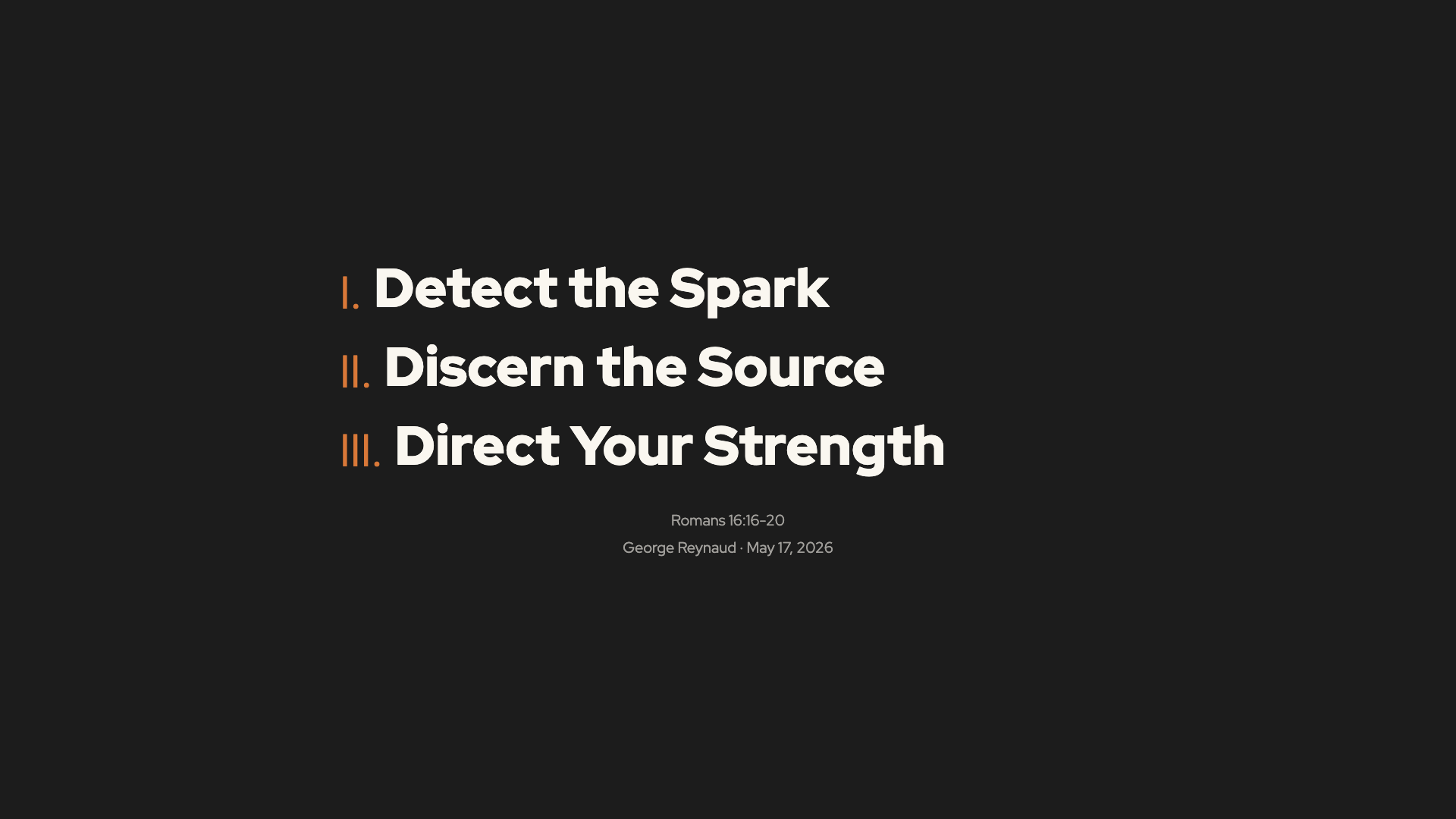
- Detect the Spark: Note division early, before it spreads. Small compromises produce catastrophic outcomes. Put your boot on the spark.
- Discern the Source: Look beneath smooth words. Deceivers serve their own appetite, target the vulnerable, and use spiritual language for selfish ends. Know the real thing so well the counterfeit is obvious.
- Direct Your Strength: Small obedience multiplies like small compromise does. God crushes Satan under your feet. Your job is to stand. His job is to win.
Paul ends Romans the way he lived: greeting saints, warning about snakes, and pointing everything to the God who wins. The closing call is simple. Protect unity. Speak truth. Plant peace. Choose obedience. Small things carry power both ways. A small compromise can spread like fire. A small act of faith can change a generation. Do not despise the day of small things. The God who crushed death in an empty tomb can handle whatever you are facing. Stand firm. The grace of our Lord Jesus Christ be with you.
Amen.
| English | Greek | Transliteration | Core Meaning |
|---|---|---|---|
| Divisions | διχοστασία | Dichostasia | Standing apart; active dissension causing factions |
| Offenses | σκάνδαλον | Skandalon | Trigger stick of a trap; stumbling block |
| Smooth words | χρηστολογία | Chrēstologia | Fair speaking; plausible speech that is hollow |
| Flattering speech | εὐλογία | Eulogia | "Good word" twisted into manipulation |
| Simple | ἄκακος | Akakos | Without evil; innocent and unsuspecting |
| Crush | συντρίβω | Syntribō | To shatter completely; total destruction |