
Pastor's Notes
God's Mission, God's Provision
And it happened after a while that the brook dried up because there had been no rain in the land. Then the word of the Lord came to him, saying, “Arise, go to Zarephath, which belongs to Sidon, and dwell there. See, I have commanded a widow there to provide for you.” So he arose and went to Zarephath. And when he came to the gate of the city, indeed, a widow was there gathering sticks. And he called to her and said, “Please bring me a little water in a cup that I may drink.” And as she was going to get it, he called to her and said, “Please bring me a morsel of bread in your hand.”
So she said, “As the Lord your God lives, I do not have bread, only a handful of flour in a bin and a little oil in a jar. And see, I am gathering a couple of sticks, and I may go in and prepare for myself and my son, that we may eat it and die.” And Elijah said to her, “Do not fear. Go and do as you have said, but make me a small cake from it first and bring it to me, and afterward make some for yourself and your son. For thus says the Lord God of Israel: ‘The bin of flour shall not be used up, nor shall the jar of oil run dry until the day the Lord sends rain on the earth.’” So she went away and did according to the word of Elijah, and she and he and her household ate for many days. The bin of flour was not used up, nor did the jar of oil run dry, according to the word of the Lord which He spoke by Elijah.
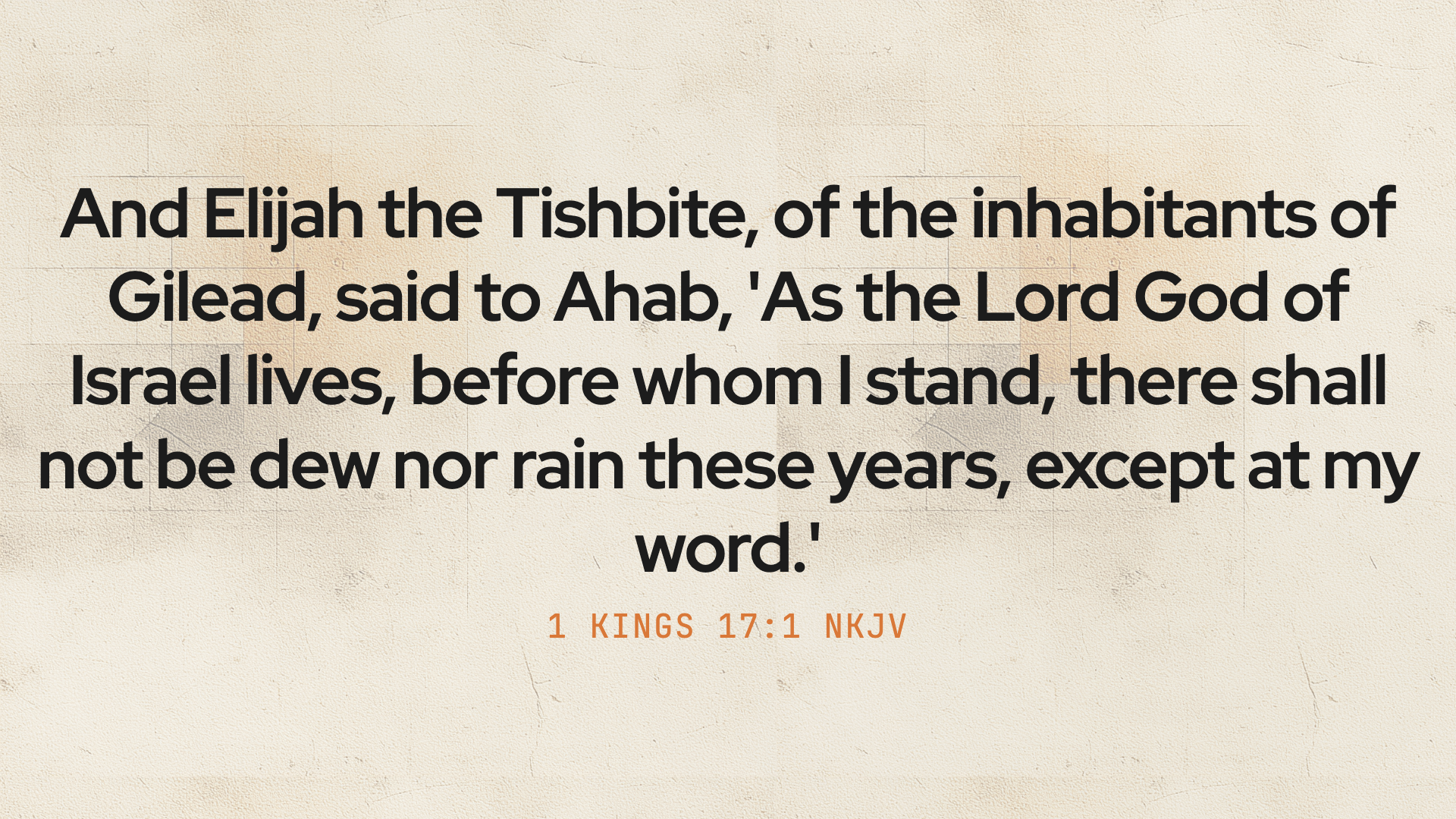
"God's Mission, God's Provision" names the central paradox of this story. Elijah steps out in obedience to announce a drought. But the moment he obeys, he is cut off. The brook dries up. He is sent to an enemy town. He depends on a widow with almost nothing. The title captures this tension. God's mission feels like separation. But throughout that separation, His provision never stops. The story teaches that obedience and isolation are not opposites. They are often companions. And where provision seems impossible, God has already made arrangements.
Context: This is the first appearance of the prophet Elijah in scripture. The context is crucial. King Ahab is documented as the most evil king Israel had ever experienced, doing evil more than all who were before him. He married Jezebel, daughter of the king of the Sidonians, and worshiped Baal. In the Northern Kingdom, Baal worship was mainstream. Baal was believed to be the god of storm and weather, the source of rain and fertility. So when Elijah comes before King Ahab and declares that rain will come only at his word, he is making a direct challenge to the entire religious system of the kingdom. He is a single man against an entrenched pagan system, a king who will seek his death, and a people who do not know the God of Israel. Into this context, God sends Elijah not to comfort or victory, but to separation and dependence.
God's Mission Requires Obedience
Elijah's boldness is only possible because he has heard from God. His mission requires stepping out in obedience even when the path is unclear and the opposition is absolute.

A. The Bold Proclamation (v. 1)
Elijah declares a drought in a land where Baal is supposed to control the weather. He does not ask permission. He does not explain himself. He makes a statement that challenges the entire religious foundation of the kingdom. The setup for this boldness is in his words: "As the Lord God of Israel lives, before whom I stand." Elijah's identity is rooted in God's presence and authority. He is not speaking for himself. He is standing before God, and God's word flows through him.
amad, "to stand": Elijah stands before the Lord God of Israel. This is not passive waiting. In Hebrew, standing before someone is a position of active readiness and service. Elijah has positioned himself so completely before God that his proclamation is God's proclamation. He is a conduit, not an independent agent.
B. The Word Creates the Reality (v. 1)
"There shall not be dew nor rain these years, except at my word." The word issued from Elijah's mouth does not simply announce what will happen. It creates it. This is the power of standing before God. When you align with God's mission, your obedience carries divine authority.
C. The Immediate Separation (v. 2)
Immediately after the proclamation, the word of the Lord comes to Elijah: "Get away from here." The obedience to the first mission (proclaim the drought) is immediately followed by obedience to a second mission (hide and wait). Elijah does not negotiate. He does not ask why. He goes.
Cherith, "Place of cutting off": Cherith derives from a Hebrew word meaning "to cut off" or "separation." The place name itself carries the message. God is not just telling Elijah to hide. He is sending him to a place named for cutting off, for isolation. The geography itself reinforces the spiritual lesson. Obedience often leads to separation.
D. Provision Promised But Not Yet Seen (v. 4)
God says, "I have commanded the ravens to feed you there." Elijah goes. He sits by the brook Cherith. He drinks from the water. But has he seen the ravens yet? The scripture does not say. What we know is that Elijah obeys based on God's word alone. He does not wait until the ravens arrive. He does not test God first. He steps out on the promise.

E. The Pattern of Obedience
Point I teaches that obedience to God's mission often requires: Bold proclamation of truth, regardless of opposition. Immediate response when God redirects. Trust in provision you have not yet seen. Willingness to be separated from your previous position and comfort.
Application: Where is God calling you to obedience? Not a suggestion. Not a possibility. A call. Elijah's first obedience was to speak truth to power. His second obedience was to accept isolation. Both were non-negotiable. Both required him to stand before God and act on what he heard, not what he could see. What obedience is God asking of you today that feels impossible because you cannot see the outcome?

God's Mission Reveals Dependence
The brook dries up. The ravens stop coming. Elijah is sent to a widow in an enemy town with almost nothing. God systematically removes every prop except His own presence, forcing absolute dependence.

A. Provision through an Unlikely Source (v. 6)
"The ravens brought him bread and meat in the morning and bread and meat in the evening." Ravens are unclean birds in Jewish law. They are scavengers. A righteous man should have no association with them. Yet God uses them to feed His prophet. This is intentional. God is teaching Elijah (and us) that His provision does not come through clean channels or expected sources. It comes from God, through whatever means He chooses.
orev, "ravens": Ravens were considered unclean under Jewish dietary law. Using them as provision is a direct challenge to the letter of the law while affirming its spirit. God is not bound by our categories of clean and unclean. His provision is not limited by what we think is acceptable. He will use the unexpected, the undesirable, the unclean to teach us trust.
B. The Drought Affects the Provider Too (v. 7)
"And it happened after a while that the brook dried up because there had been no rain in the land." The very drought Elijah proclaimed dries up the source that was feeding him. This is the genius of God's design. Elijah is not in a situation where his comfort or survival is secondary. His comfort and survival are directly threatened by his own obedience. He prayed for the drought. The drought came. Now he must drink from a brook that is drying. The provision is shrinking. This forces the question: is your faith in God, or in the provision that comes from God?
C. Refining through Zarephath (v. 8)
God says, "Arise, go to Zarephath." Zarephath means a place of refinement, a place where metals are purified by fire. It is not in Israel. It is in Sidon, Jezebel's homeland. Elijah is sent not to safety but to enemy territory. Not to a place of prosperity but to a place of refinement.
Zarephath, "Place of refinement": The name derives from a root meaning "to refine" or "to purify metals." God is sending Elijah to a place that symbolizes refinement. The removal of impurities. In our lives, the seasons that feel like refinement, like heat and pressure, are often the seasons where God is burning away what does not belong.
D. The Widow's Situation (v. 12)
The widow has come to the end of herself. She has "a handful of flour in a bin and a little oil in a jar." She is gathering sticks to cook a final meal for herself and her son before they die. This is absolute destitution. This is the place where human strength cannot sustain you. This is where dependence on God is not a nice addition to your life. It is the only way forward.
isha, "widow": A widow in ancient Israel was among the most vulnerable members of society. No husband to provide. No social safety net. The widow represents complete dependence. Yet God chooses her to provide for His prophet. In the kingdom of God, weakness becomes strength. Vulnerability becomes the place where God's power is seen.

E. The Pattern of Refinement
Point II teaches that dependence on God's mission often requires: Trusting provision that comes through unexpected channels. Losing the provision you depended on so you learn true dependence. Being moved from your place of comfort to a place of refinement. Arriving at a place where human effort cannot save you.
Application: God will sometimes reduce your resources so that He can increase your reliance. This is not punishment. This is refinement. It is the process by which God teaches you that He is your actual source, not your job, your savings, your family, or your circumstances. Where has God reduced your resources? What has dried up in your life? The answer is not that God has abandoned you. The answer is that He is teaching you to depend on Him alone.
God's Mission Receives God's Provision
The widow makes the choice to give from her scarcity. Elijah speaks God's promise. The flour multiplies. The oil never runs dry. Providence is not luck. It is the orchestrated provision of a God who has made arrangements before you ever arrived.

A. The Challenge to Give (v. 13)
Elijah arrives asking for water and bread. The widow responds with her reality: "I do not have bread, only a handful of flour in a bin and a little oil in a jar. And see, I am gathering a couple of sticks, and I may go in and prepare for myself and my son, that we may eat it and die." Elijah's response is startling. He does not offer comfort. He does not offer pity. He says, "Do not fear. Go and do as you have said, but make me a small cake from it first and bring it to me, and afterward make some for yourself and your son." He is asking her to give from her scarcity. He is asking her to trust a God she does not yet know through a prophet she has just met.
B. The Promise of Multiplication (v. 14)
"For thus says the Lord God of Israel: 'The bin of flour shall not be used up, nor shall the jar of oil run dry until the day the Lord sends rain on the earth.'" God is making a conditional promise. Not "give to me and you will be blessed." But "the Lord has ordained that your flour will not run out and your oil will not run dry." This is different. This is not a reward for the widow's obedience. This is the arrangement God has already made. The widow is simply entering into what God has already prepared.
C. Obedience Precedes the Miracle (v. 15)
"So she went away and did according to the word of Elijah." The miracle does not come first. The obedience comes first. She acts on a promise she does not understand, from a God she does not know, through a prophet who is a stranger. She gives from her scarcity. Only then does the provision begin. Obedience opens our eyes to God's provision.

D. The Provision Is Exact (v. 16)
"The bin of flour was not used up, nor did the jar of oil run dry, according to the word of the Lord which He spoke by Elijah." The provision is not abundant overflow. It is not extravagant blessing with money left over. It is exact. Day after day, the widow uses flour and oil. Day after day, they are renewed to exactly the right level. This speaks to the intimacy and intelligence of God's provision. He does not provide carelessly. He provides exactly.
E. The Gospel Pattern
This entire narrative is a picture of the gospel. God's mission (salvation) requires obedience (faith). Following Jesus feels like separation and loss. But God's mission reveals dependence. You are stripped of self-reliance and made dependent on God. Finally, God's mission receives God's provision. The provision has already been made before you believed. Jesus died before you were born. Redemption is offered to every widow who has come to the end of herself. And provision flows to those who give from their scarcity.
F. The Sahara and the Amazon
There is a fact of atmospheric science that perfectly illustrates this truth. The Sahara Desert, thousands of miles away in Africa, sends 27 million tons of nutrient-rich dust across the Atlantic Ocean to the Amazon rainforest in South America, 500 miles away. The Sahara is dying. Its nutrients are being carried away by erosion. But that erosion supplies exactly what the Amazon needs to live. Two systems, separated by an ocean, connected by an invisible flow. Creation itself testifies that God's provision operates on a scale we cannot see.
Application: Where God sends you, God provides for you. This is not a guarantee that you will be comfortable. This is a promise that you will be sustained. The provision may come through unexpected channels. The provision may require you to give from your scarcity. The provision may strip away every other source so you learn that it comes from God alone. But the provision will be there. Exactly. Reliably. Intimately. Do not despise your Zarephath. God has made arrangements.

Closing
Elijah's story does not end in 1 Kings 17. But this chapter establishes the pattern that defines his entire life. Obedience. Separation. Dependence. Provision. A man of God stands before the Lord and acts on what he hears, not what he sees. He loses the comfort he once had. He finds himself in a place of absolute dependence. But he discovers that God's provision is exact, intimate, and personal. The sermon closes with a challenge: Do not despise your chair (your place of separation). Do not fear your Zarephath (your place of refinement). God's mission always requires obedience. God's mission always reveals dependence. And God's mission always receives God's provision. The same God who sustained Elijah will sustain you.
Summary of Points
- God's Mission Requires Obedience: Elijah speaks truth to power and steps out on God's word alone, without seeing the outcome. Obedience to God's mission often means boldness followed by separation.
- God's Mission Reveals Dependence: The brook dries up. The widow is at the end of herself. God systematically removes every prop except His presence, forcing you to depend on Him alone. This is not punishment. This is refinement.
- God's Mission Receives God's Provision: The widow gives from her scarcity. The flour multiplies. The oil never runs dry. God's provision is exact, personal, and orchestrated. It comes before you believe. You simply enter into what He has already arranged.
Scripture Cross-References
| Reference | Use in Sermon |
|---|---|
| 1 Kings 17:1–16 | Primary text; the complete narrative of obedience, dependence, and provision |
| 1 Kings 16:30–34 | Context; Ahab is the most evil king Israel has known |
| Hebrews 11:1 | Faith is the substance of things hoped for, the evidence of things not seen |
| James 5:17–18 | Elijah was a man with a nature like ours; he prayed earnestly and God provided |
| Luke 4:25–26 | Jesus recalls this story to show God's provision to a Gentile widow |
| Romans 5:3–5 | Afflictions produce endurance, endurance produces character, character produces hope |
| Luke 12:24 | Consider the ravens: God feeds them, how much more valuable are you |
| Philippians 4:19 | My God will supply all your needs according to His riches in glory |
Hebrew Word Studies: Quick Reference
| English | Hebrew | Transliteration | Core Meaning |
|---|---|---|---|
| stand | עָמַד | amad | Active readiness and service before someone; positioned to receive and act |
| Cherith | כְרִית | Cherith | Place of cutting off; derived from "to cut off" or "separation" |
| ravens | עוֹרֵב | orev | Unclean birds; God's provision through unexpected and undesirable channels |
| Zarephath | צָרְפַת | Zarephath | Place of refinement; derived from "to refine" or "to purify metals" |
| widow | אִשָּׁה | isha | Vulnerable member of society; represents complete dependence and God's care for the weak |
