
Pastor's Notes
Back to Prayer
Luke 11:1-4 (NKJV)
Why "Back to Prayer"? This is week two of the Back to the Basics series. Last week Pastor George preached on our foundation, the supremacy of Christ. This week the basic is prayer. The disciples did not ask Jesus for a technique. They watched Him pray, and it moved them to say, "Lord, teach us to pray." Getting back to prayer means recovering that same relationship with the Father. If the church is going to live as the body of Christ, it will take us praying again, daily, knowing exactly who is listening.
Context: Jesus is heading toward Jerusalem, teaching His disciples how to live once He is gone. In the middle of that journey, the disciples watch Him pray. Something about the way He prayed captivated them. Prayer was already normal for Jewish people. Most prayed three times a day and memorized formal prayers, and rabbis taught that long prayers were more likely to be heard. But when the disciples ask Jesus, they are not asking for words to memorize. They are asking for His relationship with the Father. He had already given a version of this prayer in Matthew 6. That He does not repeat it word for word here tells us it was never meant to be a magic formula. It is a model for how we approach God.
To Pray Like Jesus First Takes Right Perspective
Notice the disciples do not say "teach us how to pray." They say "teach us to pray." Sometimes our greatest need is not a method but the heart to simply pray again, and again, and again, knowing how to approach the Father. Jesus starts by fixing our perspective. Before we ask for anything, we need to see who God is and who we are to Him.
A. Prayer begins with relationship, not religion.
In the very first line, Jesus reveals God as Father. That would have surprised people. Most Jewish prayer emphasized God's holiness, greatness, and majesty. Jesus keeps all of that, but He begins with relationship. Israel occasionally called God Father as a nation, but individuals rarely approached Him that way. Picture a child walking into his father's office. Employees have to knock and clients have to schedule, but the child walks right in, because the child belongs. Being family gives you access. Then Jesus glorifies Him, "hallowed be Your name," meaning your name is like none other, set apart from everyone and everything. Perspective holds both truths together: He is holy, and He is Father.
patēr, "father": The word Jesus places first. Elsewhere He prays using the Aramaic Abba (Mark 14:36), the warm, familiar word a child uses for a trusted father. Paul says the same Spirit now lets us cry "Abba, Father" (Romans 8:15). Prayer does not start by proving ourselves worthy to be heard. It starts by remembering we already belong.
B. It also means depending on Him one day at a time.
"Give us day by day our daily bread." This is dependence on God, and notice the rhythm: not once a month, not once a week, every day. The picture reaches back to Israel in the wilderness, gathering manna. They could not store it for tomorrow, because it would spoil. They had to rely on God every single day. Too often we live off yesterday's prayer, or last week's prayer. Jesus teaches us to wake up and say, "God, help me sustain today. Help me be a parent today, a spouse today, an employee today." There is nothing weak about depending on God like that. It is simply what an honest child looks like in front of a Father who provides.
epiousios, "daily, needful for existence": A rare word that barely appears anywhere outside this prayer. It carries the sense of bread needed for the coming day, enough for right now. It matches the manna picture perfectly. God gives what we need for today, and He asks us to come back tomorrow. The word itself trains us out of self-sufficiency and into daily reliance.
C. And it takes the enemy seriously.
Jesus ends, "Do not lead us into temptation, but deliver us from the evil one." He does not pray "keep Satan far from me" or "make sure evil is never near me." He prays to be delivered from the evil one. That means the enemy has schemes against you. It is not a question of if he will try, but whether you will have enough faith in God to be delivered when evil is present. That is why Jesus wants us alert and sober minded, never assuming we are somehow beyond the enemy's reach.
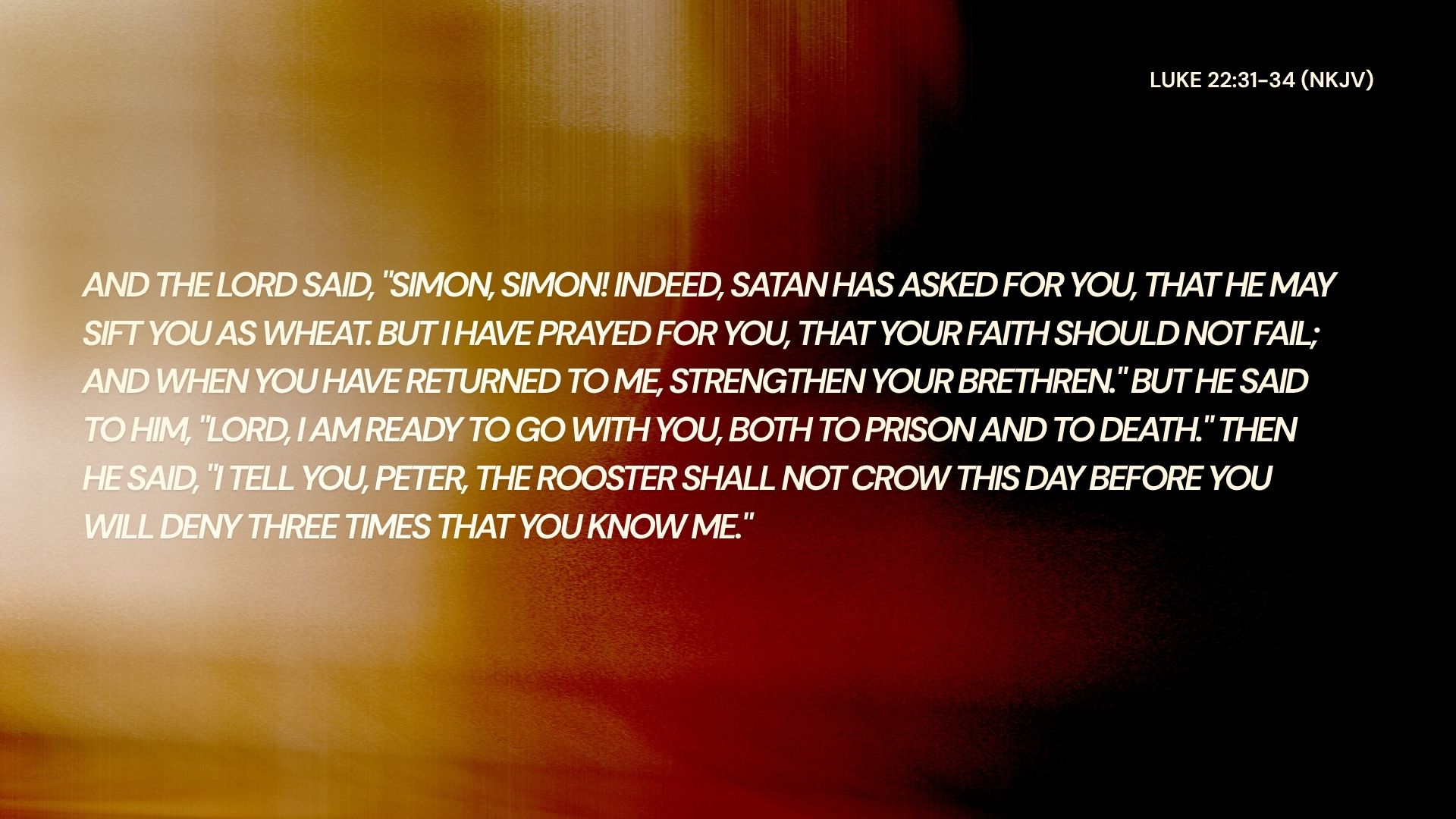
Jesus shows this to Peter. He says, "Simon, Simon, indeed Satan has asked for you, that he may sift you as wheat." He does not say "I commanded him to stay away." He says, "But I have prayed for you, that your faith should not fail" (Luke 22:31-32). The enemy stands as the accuser of the brethren, bringing charges against you day after day, waiting for a moment to prove your love for the Father wrong. What stands against him is faith. The real question in prayer becomes: where does it feel like my faith is failing, and will I ask the Father to strengthen it there?
A Model to Get You Started (ACTS): Pastor Kilton shares a simple pattern that has helped his own prayer life, one you can use when you do not know what to pray. It follows the same order Jesus does: start with who God is, then deal with sin, then gratitude, then requests.
| Letter | Step | What It Looks Like |
|---|---|---|
| A | Acknowledge | Start by naming who He is to you, the way Jesus starts with "our Father." |
| C | Confession | Confess your sins and ask forgiveness, and forgive anyone you need to forgive. |
| T | Thanksgiving | Thank Him for every good thing in your life. |
| S | Supplication | Bring requests for loved ones, and then close by praying for yourself. |
Therefore: Before you ask God for anything this week, spend the first minute of prayer on perspective. Name who He is to you as Father, thank Him, and ask Him to strengthen your faith in the one area where it feels like it is failing. Let the request come after the relationship, not before it.
Persistence Matters
After giving the model, Jesus tells a story. A man goes to his friend at midnight asking for three loaves, because a guest has arrived and he has nothing to set before him. The friend shouts back from bed, "Do not trouble me, the door is now shut, and my children are with me. I cannot rise and give to you." Yet Jesus says, because of the man's persistence, the friend will get up and give him as much as he needs.

A. This is an argument from lesser to greater.
Homes then were often one room. The door was barred with a heavy wooden beam. Everyone slept together on a raised platform, with the animals down on the ground. Getting up meant waking the whole household. So the neighbor is not just unwilling, he is deeply inconvenienced. The disciples would have laughed at the picture. And that is the point. Jesus is not saying God is a grumpy neighbor who has to be worn down. He is saying: if even an annoyed neighbor eventually responds to persistence, how much more will your loving Father respond to you?
anaideia, "shameless persistence, boldness": The word in Luke 11:8 for why the friend finally rises. It is more than repeating a request. It is a bold, unembarrassed refusal to give up. Jesus is not commending nagging. He is commending the kind of confidence that keeps coming to a good Father, sure that He hears.
The Friend at Midnight: The man knocking has nothing to offer his guest, so he goes to someone who does, and he refuses to leave empty handed. Prayer often works the same way. We come to God precisely because we have nothing of our own to set before the need in front of us, and we keep knocking until He supplies it.
B. Persistence does not change God. It changes us.
God stays loving even when He does not bring the thing we are praying for right away. So why would He wait? Not because He is reluctant, and not because He needs to be persuaded. He waits because the waiting is doing something in us. As we keep coming, we are being developed, sharpened, and grown. The delay is not Him being distant. It is Him forming us.
Therefore: Name one thing you stopped praying for because the answer did not come fast enough. Bring it back this week, and keep bringing it. Ask God not only to move, but to grow you while you wait.
Never Stop Pursuing Him in Prayer
Then Jesus gives a promise we can hold on to: "Ask, and it will be given to you. Seek, and you will find. Knock, and it will be opened to you. For everyone who asks receives, and he who seeks finds, and to him who knocks it will be opened." He is not describing a single request. He is describing people who keep going back to the Father, who do not stop. Those are the ones who will never be disappointed.
A. Keep asking, seeking, and knocking.
The words are not one-time actions. They describe an ongoing pursuit. Ask and keep asking. Seek and keep seeking. Knock and keep knocking. Jesus is not speaking about single activities but about people who keep returning to the Father, who hold on and continue. So if your prayer life has lacked, it may be because your faith has lacked in who you are praying to and how He will show up. Keep going, and you will find exactly what you need.
aiteō, "to ask": In Luke 11:9, "ask," "seek," and "knock" are present-tense commands, which in Greek carry the sense of continuous action. Jesus is not saying ask once. He is saying keep on asking, keep on seeking, keep on knocking. The promise "everyone who asks receives" belongs to the one who does not quit.
B. You are pursuing a Father who gives good gifts.
Jesus drives it home with a father and child. If your son asks for a fish, you do not hand him a serpent. If he asks for an egg, you do not hand him a scorpion. Even broken, ordinary fathers want good things for their kids. "How much more will your heavenly Father give the Holy Spirit to those who ask Him?" And the best gift He hands you is not some object at all. It is Himself: His presence, His Spirit, the very thing you need every single day.
C. This all runs on faith.
The thing God uses to bring good things to us is faith. "Without faith it is impossible to please God." It is the faith to trust Him when it looks like there is no way out, faith for the thing everyone calls impossible, faith for the miracle no one else can see. Jeremiah says it plainly: "Blessed is the man who trusts in the Lord, and whose hope is the Lord" (Jeremiah 17:7). The persistent, faith-filled person who keeps going back to the Father is the one who finds, who receives, for whom the door is opened.

He Is Always There: A worship leader was once asked about communing with God, and she said, "I realized that whenever I fix my attention on the Lord, He's there." Pastor Kilton describes how that rewired the way he prayed. He used to approach God like a friend who sometimes picks up the phone and sometimes does not, hoping today would be the day He answered. But every time he fixed his attention on the Lord, God was already there, waiting for him. There has never been a time He did not show up.

Therefore: Do not stop praying over your marriage, your children, that addiction, that healing, that calling. Put prayer first in the ordinary moments. Before you check social media, pray. Before you turn on the news, pray. Before you send that text or make that decision, pray. Pick one of those triggers this week and let it turn you toward the Father.
Summary of Points
- To Pray Like Jesus First Takes Right Perspective: Prayer begins with relationship, not technique. God is holy and He is your Father first, and He calls us to daily dependence and sober-minded faith against the evil one.
- Persistence Matters: If even an annoyed neighbor answers persistence, how much more your loving Father. Our persistence does not change God, it changes us as we wait on Him.
- Never Stop Pursuing Him in Prayer: Keep asking, seeking, and knocking. You are pursuing a Father who loves to give good gifts, and the best gift He gives is Himself.