
Pastor's Notes
Back to Faith
Hebrews 11:1-3 (NKJV)
Why "Back to Faith"? This is week three of the Back to the Basics series. We started with our foundation in Christ, then moved to prayer. This week the basic is faith itself. Pastor George preaches two passages side by side: Hebrews 11 gives us a definition of faith, and Matthew 8 gives us a demonstration of it in a Roman centurion whose faith left Jesus amazed. The sermon is built around four pillars: faith founded on Christ, formed through discipleship, forged through trials, and firm in the face of opposition.
Context: Hebrews 11 opens with a definition, then moves straight into examples: Abel, Enoch, and the rest of the heroes of faith we know as the "hall of faith." Matthew 8 puts that definition on its feet. A Roman centurion, a high ranking officer over a hundred soldiers, comes to Jesus on behalf of a dying servant. He never asks Jesus to come to his house. He asks for a word. And Jesus, who rarely reacts this way to anyone, marvels. The Bible tells us Jesus used this same word, "marveled," in only one other place: at the unbelief of his own hometown. God can marvel at our faith, or he can marvel at our lack of it. There is no neutral option.
thaumazō, "marveled, amazed": the exact word used of Jesus in both settings, once at the centurion's faith (Matthew 8:10) and once at the unbelief of the people from Nazareth (Mark 6:6). Jesus does not stay neutral in the face of what he sees in us. Either our faith moves him, or our unbelief does.
Faith is Founded on Christ
Hebrews 11 opens by telling us what faith is before it tells us what faith does. Faith begins by believing God's word before we see God's work. That means taking a step before you can see the whole staircase, trusting first, seeing after.
A. Faith begins before the evidence, not after it.
So many times we approach faith as if we need proof first, physical evidence first, before we're willing to walk out. But Hebrews tells us faith is the proof of what is not yet seen. That should bring us peace. We can approach life with a different kind of confidence when we know we're trusting a God who sees us through to the end, not because we've already seen the outcome, but because we know who he is.
The Tightrope Walker's Wheelbarrow: A famous tightrope walker from the 1800s was known for crossing places like Niagara Falls, adding stunts to raise the difficulty. One time he asked the crowd who believed he could cross with a wheelbarrow. They cheered. Then he asked who believed he could do it with a person riding inside. They cheered louder. Then he asked who would like to volunteer to get in. So many of us are like that with our faith. We'll cheer for what God can do, but we won't put our own weight on it. Real faith is willing to climb into the wheelbarrow.
James puts it plainly: faith without works is dead, and we're called to be doers of the word, not hearers only. It's one thing to say you have faith. It's another to put your whole weight on it, to actually follow Christ all the way rather than trusting he can save you while not trusting he can be obeyed.
hypostasis, "substance, that which stands under": the word behind "substance of things hoped for." It pictures a foundation, the actual ground something is built on, not a wish. elegchos, "evidence, proof, conviction": a courtroom word, the proof strong enough to settle a case. Together they describe faith as solid ground under your feet, not a feeling you talk yourself into.
B. The centurion's foundation was Jesus' authority, not miracles or feelings.
The centurion never asked Jesus to come to his house. He said, "only speak a word." He didn't need to see Jesus lay hands on his servant. He already trusted the authority behind the word. That's the same pattern Jesus points out to Thomas after the resurrection: "Because you have seen Me, you have believed. Blessed are those who have not seen and yet have believed" (John 20:29). Faith rests on God's word, not on visible proof.
Therefore: Name one place where you're waiting for evidence before you'll obey. Faith founded on Christ takes the step first. What would it look like to climb into the wheelbarrow this week instead of just cheering from the crowd?
Faith is Formed Through Discipleship
Genesis never explicitly says why Cain's offering was rejected and Abel's was accepted. Hebrews fills in the gap: it was faith. Abel offered in faith. Cain's response afterward, his anger, his refusal to be corrected, tells us where his heart was all along.
A. Rejection reveals faith.
If we give God a timeline, "do this by this date, or I'll step out and handle it myself," and he doesn't meet it, our response exposes whether we ever really trusted him or were just using him to get what we wanted. Was our faith in God, or was he just a genie we approached for what we could get? Our heart posture when God doesn't come through the way we expected shows us the real state of our faith.
Testing the Plank: Imagine crossing a twenty foot gap on a single wooden plank, high enough that a fall would be fatal. Before you cross, you could lay that same plank flat on solid ground and test it, put your weight on it there first, low to the ground, where it's safe to find out if it holds. James tells us to count it all joy when we face trials, because of what they produce in us (James 1:2). It's a blessing to have your faith tested here, in the safe seasons, rather than trusting an untested faith to carry you all the way to eternity.
B. Discipleship is where authority is formed, and it requires submission.
The centurion says something easy to miss: "I too am a man under authority." Not "I have authority." A centurion already commanded a hundred soldiers, an elite, high ranking position. Most people in his position would have led with their own authority. Instead he leads with whose authority he's under. That's the order faith follows too. It's only through submission that a disciple's heart is actually strengthened and given authority.
exousia, "authority, delegated power": the word behind the centurion's whole argument. He has exousia only because he stands under exousia. It's the same word used elsewhere for Jesus' authority to forgive sins and cast out demons. Authority is never self-generated. It's always received from the one you submit to.
The Officer in the Road: A police officer has been sworn in, but he works under the authority of the state. When an officer stands in the middle of the road and stops traffic, it's the authority he's under that lets him do it. The moment he's no longer under that authority, the power to enforce anything is gone. It's the same with discipleship. If you're not submitted to some form of leadership, you're not under power.
Jesus himself modeled this. The Son who calmed storms, cast out demons, and raised the dead was the same Son who prayed, "not My will, but Yours, be done." Not because he was inferior to the Father, Father, Son, and Spirit are equal in deity, but because in his incarnation he voluntarily took the role of obedient servant. If perfect submission marked Jesus' ministry, submission is never beneath us. Titles make managers. It's the people who choose to follow you that make you a leader.
| Conditional Faith | Confident Faith |
|---|---|
| Trusts God only if he meets my terms | Trusts God because of who he is |
| Breaks the moment he doesn't deliver on my timeline | Stays steady whether the answer comes or not |
| Treats God like a genie | Treats God like a Father |
| Cain's response after rejection | The centurion's "only speak a word" |
Therefore: Who are you submitted to for accountability? Not just the Word of God in general, but a person who has permission to tell you no. If you can't name one, that's the place to start this week.
Faith is Forged Through Trials
Enoch walked with God in an increasingly wicked generation and was taken away without experiencing death. Genesis tells us he walked with God for three hundred years, long after his son Methuselah was born. That's not a burst of spiritual enthusiasm. That's decades of showing up.

A. Forging happens in the daily walk, not just the crisis.
A blacksmith refines metal through fire and hammering. It's uncomfortable, but that's the process that shapes it. God is forging our character to look more like Jesus the same way, through experience, through resistance, through choosing to stay in step with him when the culture is pulling us somewhere else. Enoch spoke God's truth even when it was unpopular, and he persevered for decades before the forging was finished.
B. Trials don't create faith, they reveal and refine what's already there.
The centurion's servant was dying, and that pain pushed him toward Christ instead of away from him. He risked persecution from his own men and from the Jewish leaders who favored him to publicly ask a Jewish rabbi for help. His crisis became the furnace where his faith was revealed. Many of us only discover the strength of our faith after we enter the fire.
Job understood this after everything he lost: "When He has tested me, I shall come forth as gold" (Job 23:10). God is sifting for gold faith, and we're told to seek him diligently until he himself becomes our reward.
The Gold Bell in the Dirt: In 2011, archaeologists in Jerusalem finished years of digging through thousands of tons of dirt and debris. Bucket by bucket, sifted by hand, they finally found a tiny gold bell, half an inch across, that still made a faint sound when shaken. It matched Exodus 28's description of the gold bells sewn onto the hem of the high priest's robe. One of the archaeologists said an archaeologist can dig his whole life and never find something like it. That is what our walk of faith often looks like, digging and digging with no guarantee, but trusting that what we find will be worth more than the years it took.
That same patience shapes discipleship. Pastor George shared discipling juveniles in detention facilities for six years, sharing the gospel with kids from deep trauma, some of whom went on to reoffend or worse, while still believing that even one changed heart made every year of showing up worth it.
Therefore: If you feel like you've been digging in the same dirt for years with nothing to show for it, don't stop a bucket too soon. The trial you're in right now may be the forging, not proof that God has forgotten you.
Faith is Firm in the Face of Opposition
Without faith it's impossible to please God, since anyone who comes to him must believe that he exists and that he rewards those who diligently seek him. The reward for seeking him is him, not merely what he can give.
A. The centurion crossed real barriers to stand firm.
He risked criticism from fellow Romans for kneeling to a Jewish rabbi and risked losing favor with the Jewish leaders who valued him. Everything around him said this wouldn't work. He humbled himself anyway and said, "just speak the word." That pleased Christ so much that Jesus stopped and marveled out loud, in front of a crowd.
B. The kingdom is entered by faith, not by birthright.
Right after healing the servant, Jesus says many will come from east and west to sit with Abraham, Isaac, and Jacob, while the sons of the kingdom, those who assumed their heritage secured their place, will be cast out. A Gentile soldier with no covenant history is welcomed in, while some who carried the covenant in their blood are shut out. Paul makes the same point: not all who descend from Israel are truly Israel, and those who have faith are Abraham's sons (Romans 9:6-8, Galatians 3:7). Belonging to God's family has never run through ancestry. It runs through faith.
Therefore: If Jesus walked into your Monday, your Tuesday, your week, would he marvel at your faith or your unbelief? Answer honestly, then let that answer set your next step.
Paul closes his life the same way this sermon closes: "I have fought the good fight, I have finished the race, I have kept the faith. Now there is laid up for me the crown of righteousness, which the Lord, the righteous Judge, will give to me on that Day, and not to me only but also to all who have loved His appearing" (2 Timothy 4:7-8).
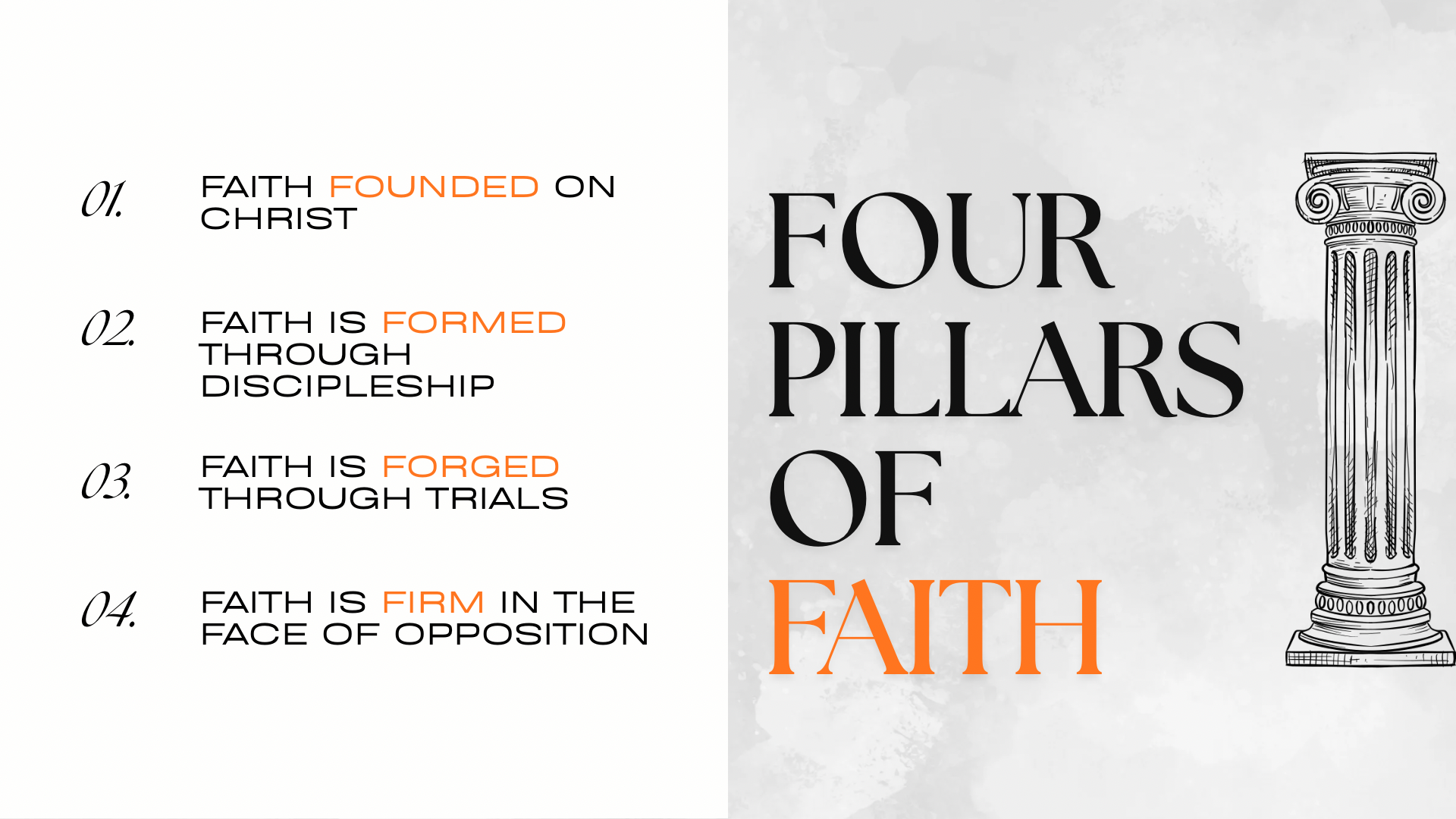
Summary of Points
- Faith is Founded on Christ: Faith trusts God's word before it sees God's work, resting on who Christ is, not on visible proof.
- Faith is Formed Through Discipleship: Faith grows through submission to real accountability. Authority is only ever received, never self-made.
- Faith is Forged Through Trials: Trials don't create faith, they reveal and refine it, and the forging happens in the daily walk, not only the crisis.
- Faith is Firm in the Face of Opposition: Faith stands even when culture, pride, or public opinion say don't, because the kingdom is entered by faith, not birthright.